
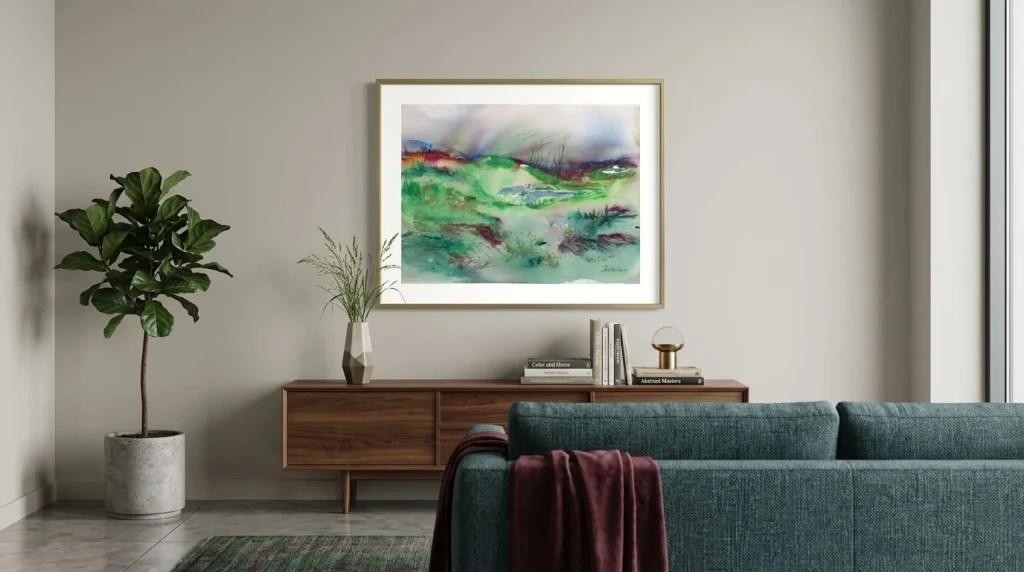
Choosing framed abstract wall art is rarely a straightforward decision.
Unlike decorative prints that simply “match a wall,” abstract art interacts with a space. It changes how a room feels, how light behaves, and even how people move through it.
As an abstract artist, Shirley Rosin Art often notices a pattern in how buyers approach their first piece. Most begin by asking practical questions, Will this match my sofa? Is it too bold? Is it too big? But the final decision almost always shifts toward something less logical and more instinctive.
They stop choosing with their eyes alone.
They start choosing with feeling.
That shift is usually where the right artwork is found.
This intuitive approach is one reason abstract art continues to gain popularity in contemporary homes. As explored in Why Abstract Watercolor Landscape Art Is Trending in Modern Interiors, homeowners are increasingly choosing artwork that creates atmosphere and emotional connection rather than simply matching existing décor.
This guide breaks down how to choose framed abstract wall art not just as decoration, but as a meaningful part of your home.
One of the most important decisions happens before you even look at a piece.
Ask a simple question:
What do I want this wall to do for my space?
From experience, artwork in homes typically plays one of four roles:
For example, in living rooms, buyers often lean toward framed abstract wall art with stronger movement and contrast because the space naturally invites activity and conversation.
In bedrooms, the opposite happens. People subconsciously choose softer transitions, muted tones, and less aggressive brushwork, even if they initially thought they wanted something bold.
This is where intuition tends to override intention.
And usually, that instinct is correct.
Over time, clear patterns emerge in how people respond to abstract art:
These buyers are drawn first to palette. They often say, “It matches my room perfectly.”
They usually prefer harmony and cohesion. However, they sometimes overlook composition and end up with pieces that feel visually flat in the long term.
These buyers cannot always explain why they like a piece. They say things like, “I just keep coming back to it.”
In practice, these are often the most satisfying long-term purchases.
These buyers think in terms of structure, layout, and interiors. They consider scale, wall proportion, and furniture alignment.
They are the most methodical, but sometimes take longer to emotionally commit.
A strong framed abstract wall art piece usually satisfies at least two of these three categories.
If it hits all three, it rarely feels like a mistake later.
Most people focus on color first. Designers often focus on something else entirely: visual weight.
Visual weight is how “heavy” or “light” an artwork feels in a room.
This matters more than most people realize.
For example:
A large dark abstract piece above a low sofa can anchor a room and create sophistication.
But the same piece in a small, dim room may feel overwhelming rather than impactful.
Good placement is not about matching; it is about balancing visual weight with space.
One of the most common observations in buyer behavior is underestimating scale.
People tend to buy artwork that feels “safe” in size.
But framed abstract wall art rarely looks its best when it is too small.
A useful interior principle:
Above sofas or beds, artwork should ideally occupy around two-thirds of the furniture width. This is not a strict rule, but it prevents the most common design mistake: artwork that feels disconnected from the space.
Another overlooked insight:
Horizontal abstracts tend to expand a room visually, while vertical compositions add height perception. This alone can change how proportioned a space feels.
Frames are often treated as secondary, but they significantly affect how framed abstract wall art is perceived.
From an artist’s perspective, framing changes emotional tone:
A strong piece can be weakened by the wrong frame choice. Equally, a simple piece can be elevated dramatically with the right one.
Framing is not decoration; it is presentation.
This is where most decision errors happen, not in taste, but in interpretation.
Matching is not the same as harmony. A piece can complement a room without repeating its palette.
Small artwork on large walls rarely creates impact. It often reads as unfinished rather than minimal.
A piece may feel exciting initially but visually exhausting over time if it is too intense for the space it occupies.
When everything in a room competes for attention, framed abstract wall art loses its presence.
Good interior design allows artwork to breathe.
After observing how collectors evolve their choices, one pattern is consistent:
People start by selecting art that matches their home.
But they end up loving art that shapes their home.
The difference is subtle but important.
One is decorative.
The other is foundational.
This is why many collectors return to abstract art again and again, it adapts to them as much as their space.
Choosing framed abstract wall art is not a technical exercise. It is a process of noticing what feels right in a space before your mind fully rationalizes it.
The most successful choices usually come from a balance of:
As Shirley Rosin Art work often reflects, abstract art is not meant to complete a wall, it is meant to change how a room feels when you live inside it.
And when you find the right piece, you don’t really ask if it fits.
You simply realize the room feels more like home.